
To understand why perimenopause can feel so chaotic, we first need to understand what happens when your reproductive system is behaving itself.
Note that every woman is different, but apparently the “average” menstrual cycle occurs every 28-32 days.
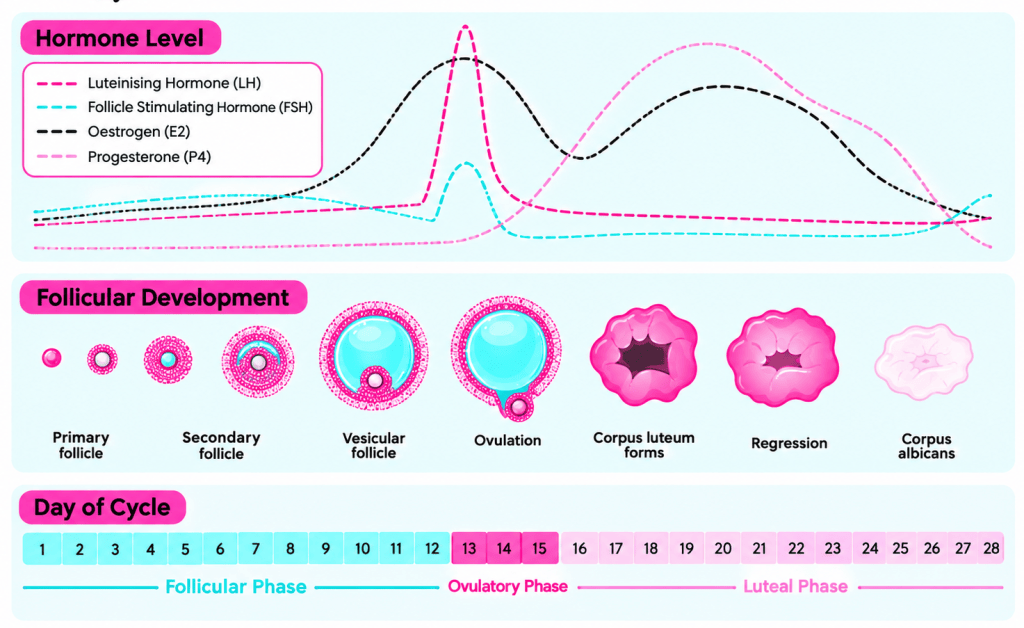
At the beginning of a menstrual cycle, your brain releases FSH — follicle-stimulating hormone.
FSH tells your ovaries:
“Righto ladies. Pick a follicle.”
A follicle starts developing…
…and as it develops, it produces oestrogen.
Oestrogen isn’t just doing stuff in your uterus.
It is also communicating back to the brain:
“Yep. We’re good. The follicle is developing.”
As oestrogen rises, the brain responds with a surge of LH — luteinising hormone.
And that LH surge helps trigger ovulation.
After ovulation, the remnants of that follicle become the corpus luteum, aka. a gland which produces progesterone.
And progesterone helps maintain the uterine lining in preparation for a possible pregnancy.
If pregnancy doesn’t occur, progesterone falls…
…the lining sheds…
and hello, period.
When everything is working properly?
It is a fucking beautiful coordinated orchestra.
Brain.
Ovaries.
Hormones.
All communicating with each other…
…at roughly the right time…
…in roughly the right sequence.
FSH rises gently at the beginning of your cycle
Followed by oestrogen.
LH and oestrogen peak on around day 14 of your cycle (day 1 being the start of your period, and assuming your cycle is actually 28 ish days) – triggering ovulation, then both drop off.
Progesterone starts to rise following ovulation and peaks on about day 21.
Then all hormones return to low levels and the cycle begins again.
Magic!
Until perimenopause arrives.